Tuesday, October 31, 2006

Nonviolent self defense

Here is an interesting photo from the archives at Southern Miss.
It is a "Nonviolent self-defense" technique that was taught in Ohio in the mid 1960's. Who here can remember the standard procedure for protecting against a tornado in public schools? Now, there may be something to be said for this tactic when there is absolutely no other option (i.e. against a tornado), but the inane attitude that underlies the teaching of this as self-defense against people is kinda disturbing to me. How long do you think this woman would be able to steel herself while these two guys pound her?
There are other nonviolent options besides total passivity. Aargh! How about a quick few: don't get in that situation in the first place, run to safety, hide, stay more than arm's length from him, move out of his way, get behind him, shout for help, move with him to limit his damage potential, keep your feet under you, don't stand still...
How about this one: assert the natural law that an attacker does not have the right to kick the hell out of you while you do nothing!

Monday, October 30, 2006

Sanka-kyu


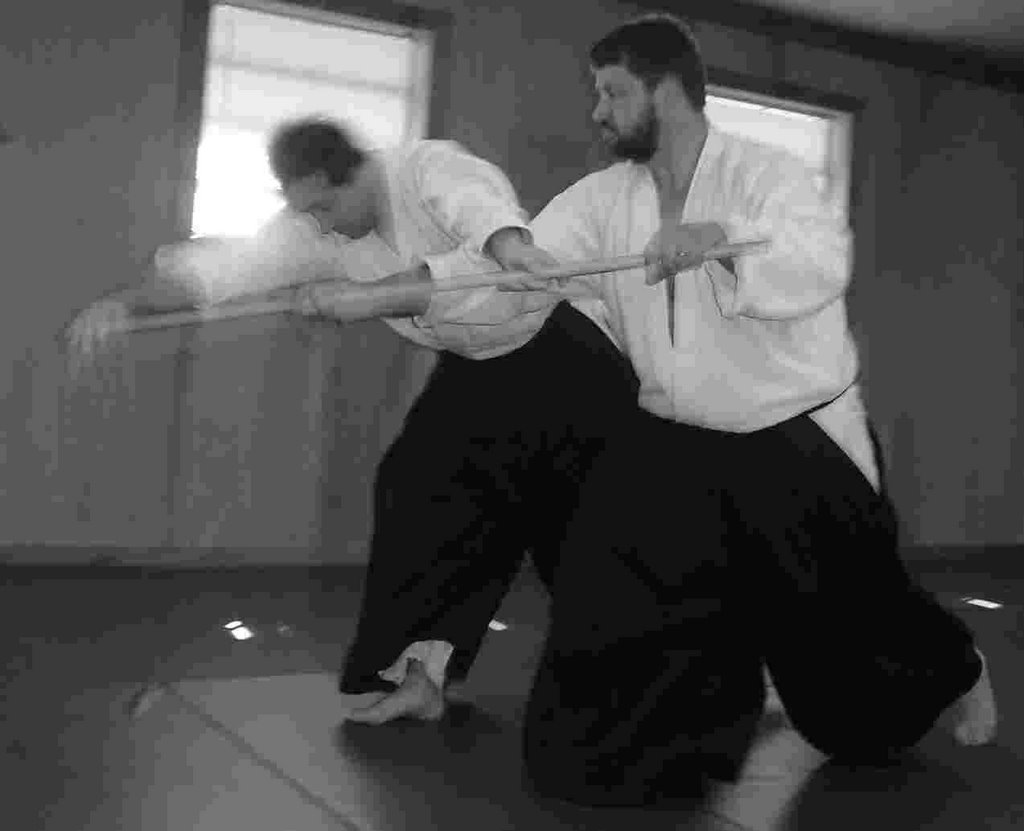
Here's a picture of Kristof trying to throw poor Dr. Wake out the front door of the dojo with hikiotoshi. That belt she is wearing is very sneaky. It's hard to tell if it is a white belt that is so dirty from ten or fifteen years of use that it almost looks brown or if it was once brown and has faded from ten or fifteen years use. The official color is "Sanka" brown but it looks more cafe aulait to me.
After class last Saturday, Amanda allowed my three year old, Knox, to repeatedly throw her HARD with tenkai kotegaeshi. We don't know where Knox came up with that throw. Before that day I would have sworn that he'd not watched me enough to pick up the technique, but he did it both perfectly and consistently on an uke that outweighs him by about four times. I've got some video but I wish I had some pics to post. Anyway, thank you, Amanda, for being such a good sport and nurturing aikido and judo in my kids.

Sunday, October 29, 2006

Fall 2006 Aiki Buddy Gathering

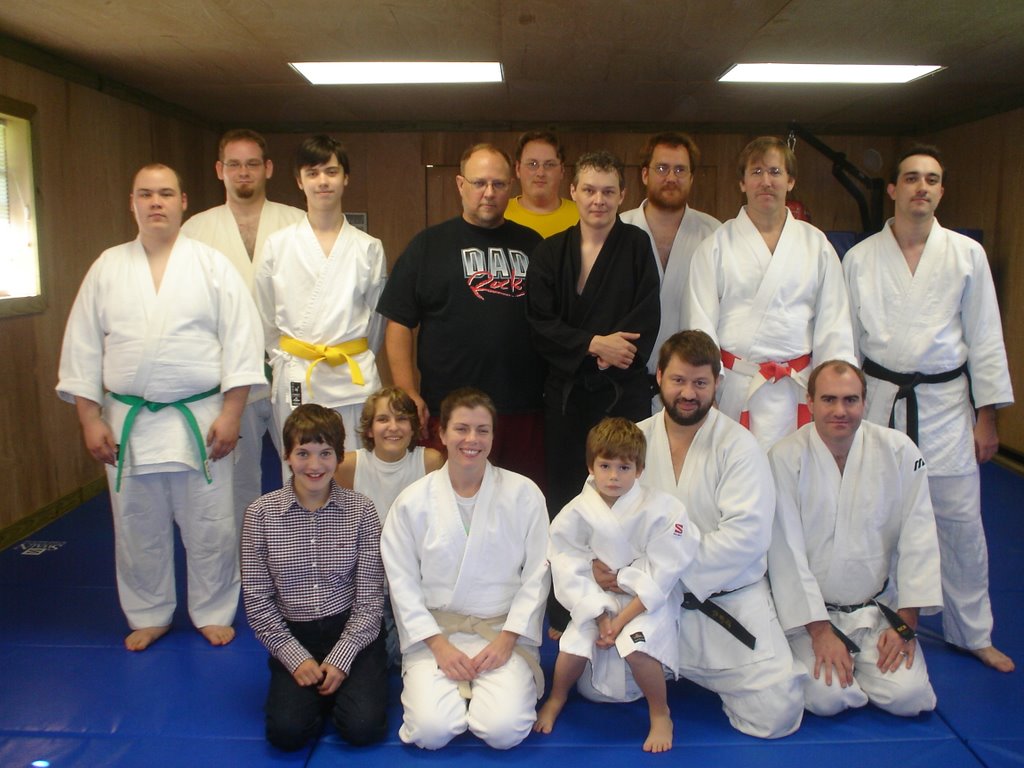
A very special thanks to everyone who participated in the Fall 2006 Aiki Buddies Gathering at Mokuren dojo in Magnolia, MS. Pictured above are: (front row L to R) Deanna Mckenzie, Mytchieko McKenzie, Amanda Wake, Whit Parker, Rich Minnis, John Kirby. (back row L to R) Chris ? (C1), Andy Sims, Kristof Tomey, Richard McKenzie, Gary Hill, Patrick McKlemurry (P4), Patrick Parker (P1), John Usher, and Patrick Waits (P3).

Saturday, October 28, 2006

Releasing

Saturday after Rich's sandan demo we all worked on the first two moves in yonkata in the context of moving just as uke crosses ma-ai and really making these two feel like releases - like the techniques of hanasu feel like releases. Usher brought up the point that since we classify yonkata as a release kata we should really be releasing the tension between the partners instead of getting the feeling of storing up potential energy in uke in preparation to really flail him.
.
We started these releases by evading diagonnally inside and forward right as uke crosses maai. If the evasion is successful then tori is free to run or do whatever but if uke manages to exert enough to get a hold on tori's arm then it constrains tori's motion while putting an awful torqing offbalance on uke. If tori is light on his feet then he is able to actually release back into an effortless otoshi throw. This type of motion makes yonkata #1 and #2 much more consistent with the idea of releasing - particularly with the hanasu #1 and #3 releases and their yonkata counterparts, chudan aigamae and chudan gyaku.
.
Usher, Kirby, and I also got to play with the third 1/3 of yonkata - the last eleven techniques that we never seem to get to play with. These are all interesting but it is particularly interesting to me how familiar thesetechniques seem after doing release followups for several years. That was part of the purpose of the development of the chains was to bring some ofthese ideas from the higher-level kata back into our release practice and from there back into our randori.
.
Next weekend is the Fall 2006 Henry clinic at Starkville and we will be working on yonkata. I can hardly wait to see what he gives us to think about and work on.

Jodori tsuki maeotoshi


Saturday afternoon we had an excellent Sandan demonstration with tori Rich Minnis and uke Patrick Waits (P3). Rich is a very fine technician and a great teacher as well as an all-around great guy. his demonstration was very nice indeed. P3 is also a very fine aikidoka who is preparing for his upcoming nidan demonstration by playing the role of uke for Rich. I look forward to seeing P3's demo soon.

Suwari ryotedori sukuinage

Here is another pic of Rich locking P3 in and getting ready to fire him home!

Now stay put, will ya?


Rolling the ball

Saturday morning John Kirby worked with us on a concept called "rolling the ball" This is apparently an exercise of FBI origin that they use for moving through a crowd efficiently. It involves light pushes, blending, and moving with the flux in the crowd. It is a fun exercise that has some interesting aiki implications. From there we worked on techniques that emphasized the pushing nature of aikido as opposed to pulling motions. We played a little bit with the idea of doing hikiotoshi (the "pulling drop") with a pushing body structure, then we explored aikinage (iriminage) with the idea of the hand on the head being both a push and a sensor to let us know when uke is trying to change the equation on us.

Friday, October 27, 2006

Keeping the bubble inflated


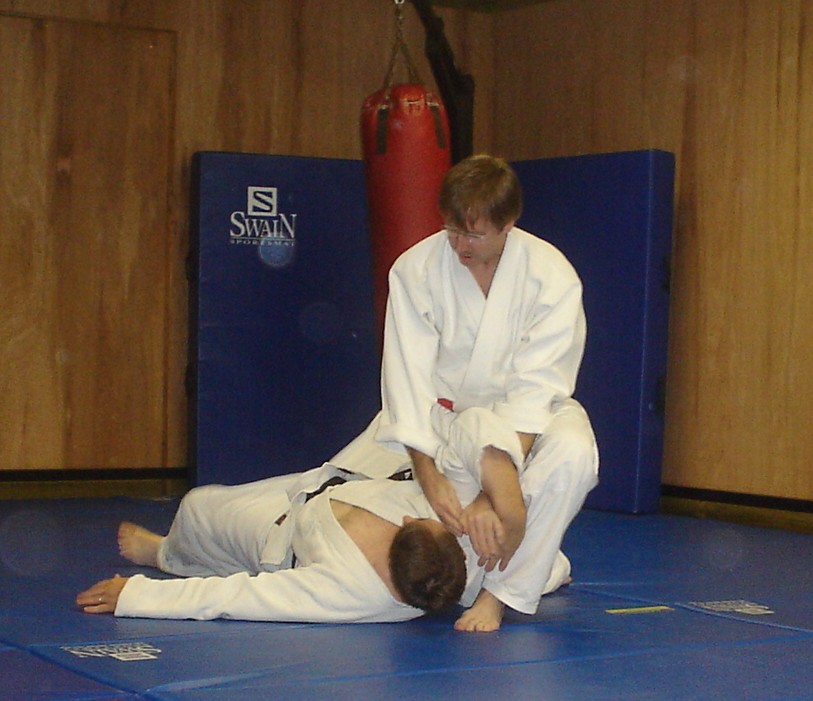
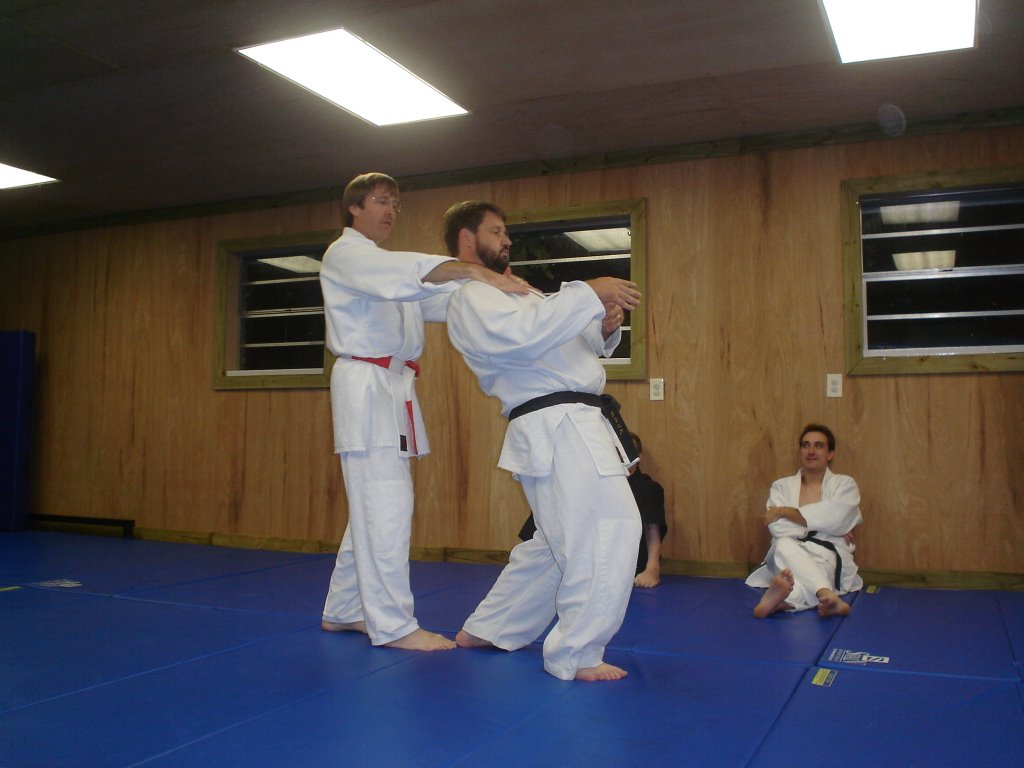
Here, Usher has kept uke extended all the way through shihonage and into the lock at the bottom. We worked on this idea of getting and keeping uke's balance as it applies to hanasu #6 & #8. Usher calls this idea "keeping the bubble inflated." I think Mike Swain ought to give me a nice fat check for product placement in this picture! How about it, Mike?

Thursday, October 26, 2006

What if...

What if it were acceptable to do yonkata#1 and #2 releasing in a wide circle around uke in a type of tenshin motion? What if we didn't have to clash together in order to get a powerful otoshi that looks like kata?
We used to have big problems with hanasu#1 because we couldn't tell whether uke was going to stiff arm or pull into an otoshi like in yonkata#3. Then I began comparing the feeling of hanasu#1 and hanasu#3. This problem almost never occurs on hanasu#3, but rather a different one. Hanasu #1 feels like tori is in a good place to exert against uke. Hanasu#3 on the other hand, feels like a release. Tori isn't as tempted to exert on #3 as #1. For years I thought it was because something was wrong with my execution of #3. I couldn't get into a strong position in that move - at least not as strong as in #1. Then I realized - what if #3 is how a release is supposed to feel? My students and I retooled our ideas about hanasu#1 and gained significant flow and release at the expense of being able to feel strong.
So, what if yonkata#1 and #2 don't have to exhibit that inward clash and driving otoshi? What if these could feel like releases - just like hanasu#1 and #3?
Check this link for Aiki Development's interesting ideas about these releases. Not exactly what i' talking about, but sorta close.

Wednesday, October 25, 2006

Owaza with Andy

Click here for details about the Aiki Buddies Gathering this weekend.
In aiki class we got started with the usual - range of motion, ukemi, tegatana, hanasu. Then we focussed in on hanasu#1 motion a little bit with tori doing several repetitions of #1 motion with uke attacking either with the correct or the wrong arm. When uke attacks with the wrong arm tori gets a release similar to yonkata#2. We worked this for a while then segued into chain #1 and nijusan - oshitaoshi, shomenate, and shihonage. Class ended with me demonstrating owazajupon several times with Andy as uke. shizumiotoshi (a.k.a. sukuinage) was working GREAT on Andy. He kept getting up and asking in wonderment, "Can you do that again?" Of course I can! ;-) I tried some gurumas on Gary for the feeling of a much larger uke and it was wonderful! Owaza is so cool !!!

Tuesday, October 24, 2006

Kagemusha

Click here for details about the Aiki Buddies Gathering at the end of the month.
Today I installed blinds in one more window of the dojo. Three down and three to go. Did some stretching and rolling then ran through owaza in my mind several times with a shadow uke. It's amazing how good I am at aikido when I have perfect ukes! If only all ukes would conform to my motions that well. Oh well.

Monday, October 23, 2006

Owaza Jupon

Perhaps my most favorite set of techniques in the our aikido syllabus is Owaza Jupon - the "Big Ten." Owaza is required for shodan and nidan rank and several of these techniques are variants of things that were previously introduced, but Owaza is different and in several ways, more "aiki" to me.
.
One way that owaza differs from junana is that owaza is a separating motion kata while junana is primarily an entering and sticking together kata. Owaza is based on that instinct to back away from an attack - so instead of trying to overcome that instinct we learn to work with it. Owaza is also traditionally done with faster attacks from uke and slightly delayed reactions from tori - so owaza is very much an exercise of "what if everything goes wrong."
.
Owaza introduces several things that are very much characteristic of aikido, though they appear to be mostly missing from earlier kata - guruma motions, iriminage, and sukuinage. Guruma is a motion in which uke is caught on one leg and rotated about a vertical axis. Most of junana is built on extending uke during an otoshi motion to cause a fall like sumiotoshi or kotegaeshi. The addition of the guruma motion in owaza adds a great deal of versatility to the system. Aikinage (iriminage) is one of the three motions that Doshu says are representative of aikido and it appears in two variations as techniques #5 and #9 of owaza. Sukuinage (a.k.a. shizumiotoshi) is also a technique that appears a lot in aiki demonstrations, in which tori ducks and clips uke's legs with his body.
.
Lately we have been experimenting with entering into owaza techniques off of a yonkata#2 release and/or ryotedori attacks. This is a fun and interesting practice that ties owaza more explicitly to yonkata and hanasu and the rest of the syllabus.

Friday, October 20, 2006

In synch but out of phase

Click here for details about the Aiki Buddies Gathering at the end of the month.
Judo classes have been sparsely attended lately. It is interesting to me how judo and aikido popularity seem to go in waves and appear to be out of phase with each other. Either one class or the other will have lots of students and right now the popular class at Mokuren is aikido.
Today there were no judoka, so I ran through my jodo and short stick with Woodreaux and then installed horizontal blinds in one of the windows of the dojo. I figured they'd just pop right up but they are a pain in the buttocks to install properly. I ended up doing one window out of seven. That should give me a good project between now and the ABG. Tomorrow I think Vincent is bringing one of his electritian buddies to install a motion light outside above the door to the dojo because when we turn the lights off it is as black as the inside of a realy black thing and people keep tripping over the duckboards I put outside the door to keep mud off folks' feet.
Related Posts Plugin for WordPress, Blogger...